Whoa. I remember the first time I saw a crypto hard wallet that felt like a credit card — slim, indestructible, and oddly satisfying to hold. My instinct said: this is finally practical. But then I started poking at the UX, the threat model, and the mobile app integration. Hmm… things looked a little less tidy. I’m biased, but I think smart-card cold wallets are the best compromise right now between real-world usability and strong security. Still, there are trade-offs. Some of them bug me, and some are real breakthroughs.
Mobile apps make crypto usable for millions. They also open the door to malware, phishing, and sloppy key management. A smart-card cold wallet — the physical card that never exposes your private keys to the phone — changes the math: the mobile app becomes a signing terminal, while the card stores the keys offline. On one hand, you get the convenience of a phone-based interface; on the other hand, you maintain a separation that dramatically reduces remote attack surfaces. But actually, wait—let me rephrase that: convenience doesn’t magically equal security. You still need to think about pairing, loss, and recovery.
First, what happens in practice. You buy a smart-card cold wallet, tap it to your phone, and the mobile app and card negotiate signatures. The private key never leaves the card. Sounds simple, right? Seriously — it’s elegant. Yet the complexity sits in the edges: firmware updates, Bluetooth or NFC stacks, biometric unlocks, and whether the card relies on a cloud backup or truly single-device custody. Initially I thought hardware wallets were all roughly the same, but then I realized how differently vendors approach recovery phrases, multisig support, and app experience. There’s no one-size-fits-all solution.
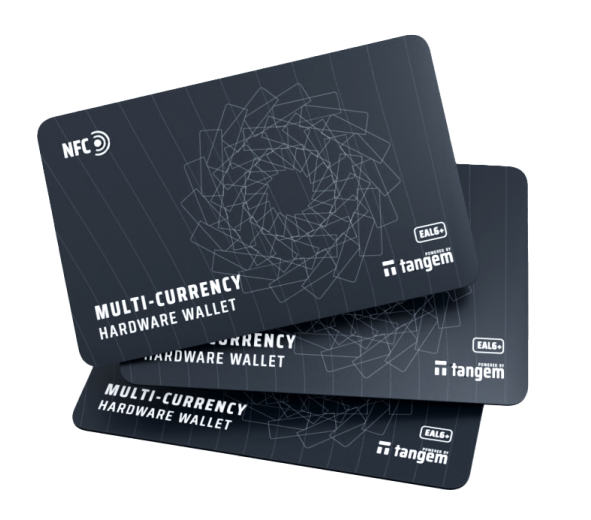
Practical Security: Threat Models, UX, and Real-World Tradeoffs (tangem)
Okay, so check this out—let’s map a simple threat model. The adversary could be a remote hacker, a compromised mobile app, a thief who steals your phone, or someone who finds your backup seed. A physical smart-card eliminates the remote hacker angle because the private key is offline. If your phone is compromised, the attacker can see unsigned transactions and metadata, but they can’t sign without the card. That matters. I’m not 100% sure every user understands that nuance right away, though.
There are caveats. If you lose the card and you haven’t set up a robust backup plan (or you use a vendor-specific cloud recovery you don’t trust), you’re toast. On the other hand, if your recovery method is a plain 24-word seed written on paper — well, that’s vulnerable to theft or loss. Many users want both: simple recovery and strong security. Solutions vary: some smart-card systems support encrypted cloud backups that can be recovered with a password, others integrate with multisig setups, and a few (I like this) let you combine a local hardware backup with an offsite encrypted copy.
Product-wise, a few names stand out because they nailed that balance between ease and safety. For example, tangem makes a line of smart-card wallets that pair seamlessly with mobile apps and are built for everyday use. Their model leans into simplicity: tap to sign, no seed phrase for basic setups (some users love that; others worry about vendor lock-in), and durable hardware that survives pockets, wallets, and even a short drop. I’m comfortable recommending it as a strong option for people who want a slick mobile-first experience with cold-key guarantees.
But let’s be honest. The mobile app matters. A gorgeous card is useless with a buggy app. The app must do these things well: validate transaction details locally, present clear human-readable addresses (not just hashes), support firmware checks, and provide a secure pairing flow that resists relay attacks. If the app offloads too much trust to a server, the whole point of the card is undermined. On the other hand, making every security step friction-heavy kills adoption. There’s a tight rope here — and companies are still learning to walk it.
One real-world user story: I gave a smart-card wallet to a friend who is not technical—she uses a phone and wants to pay and trade without babysitting seed phrases. At first, she loved it: taps and transactions were fast and reassuring. Then she misplaced the card once. Panic ensued. Her backup was an encrypted cloud recovery tied to her email, which we set up together. It worked, but she later told me she felt uneasy about depending on a vendor-managed recovery. That hesitation is valid. The best systems give clear, user-friendly options: manual seed, split secrets, or vendor-assisted recovery, spelled out in plain language.
When designing your own security approach, think about these practical questions: How often will you transact? Are you frequently on the go? Do you need multisig for business-level safety? How much trust are you willing to place in a vendor for recovery? For collectors or long-term holders who rarely move assets, an air-gapped multisig approach may make sense. For someone who uses crypto daily, a smart-card + mobile app hits the sweet spot.
There are also ecosystem considerations. Apple and Google control the NFC/Bluetooth APIs on phones, and their security models shape what vendors can do. US users often expect slick onboarding like consumer banking apps, and that’s a pressure on wallet makers. It’s a tricky balance between adhering to mobile platform constraints and preserving cryptographic guarantees. Some vendors accept small trade-offs for smoother UX; others double down on pure cryptography and accept some onboarding friction.
One technical nitpick that bugs me: too many apps show transaction previews that are hard to parse. If a transaction contains a smart contract call or token swap, the raw data is meaningless to most people. A good mobile companion decodes intent, explains what permissions are being granted, and highlights amounts in fiat terms. Without that, social engineering and phishing can still win, even with a smart-card signing solution.
FAQ
How is a smart-card cold wallet different from a regular hardware wallet?
Both store private keys offline, but smart-card wallets are typically designed to be ultra-portable (credit-card form factors) and to interact via NFC or Bluetooth with mobile apps. Many prioritize tap-to-sign simplicity and consumer-level durability, while traditional “brick” hardware wallets often target power users with desktop-centric workflows and explicit seed backups.
What happens if I lose my smart-card?
It depends on your setup. If you used a seed phrase or multisig backup, you can recover funds. If you relied solely on vendor-managed recovery, follow their documented recovery steps — but verify the vendor’s security model first. Best practice: have a tested, documented recovery plan before sending large amounts to any wallet.